
Two views of health are moving closer together
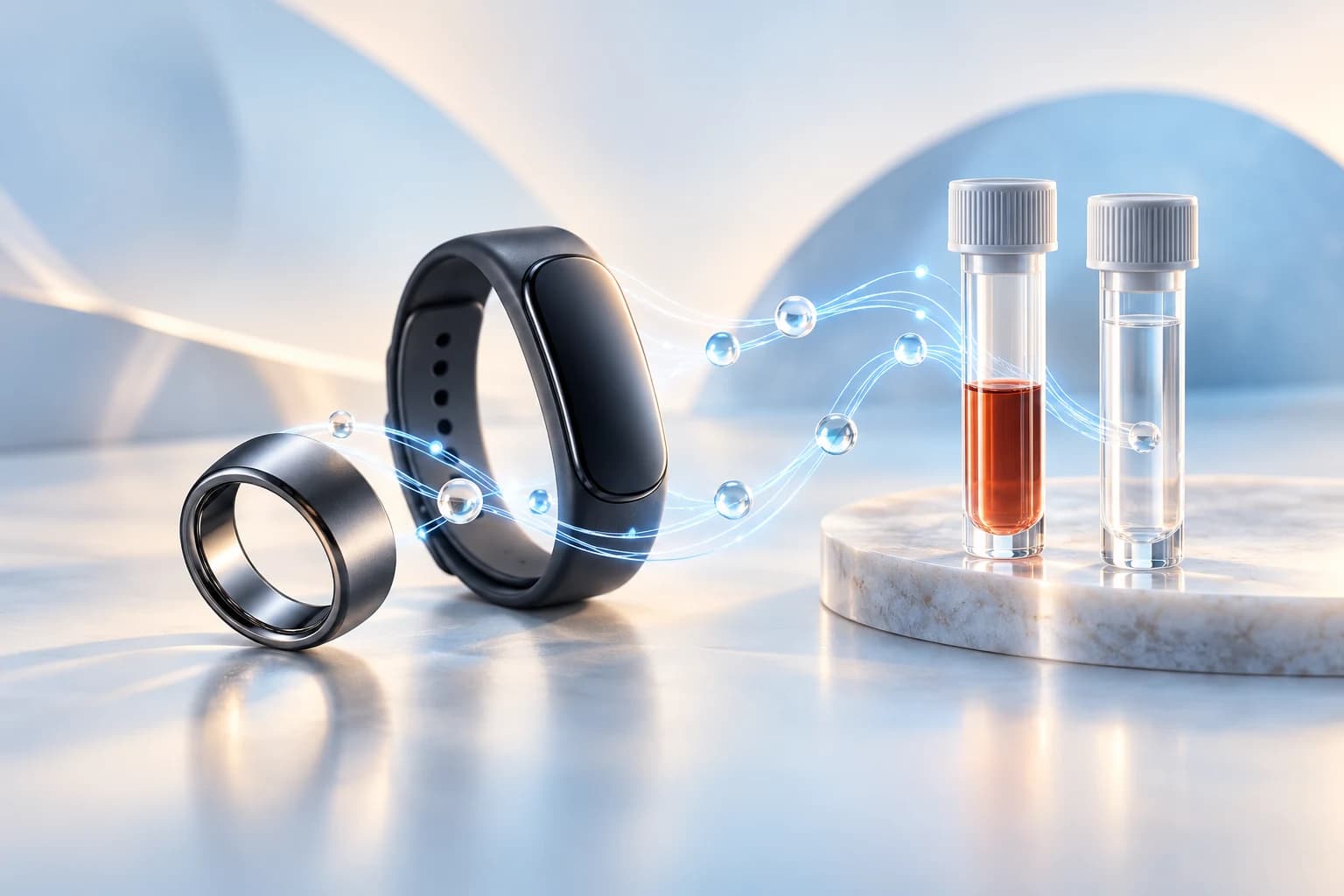
Your wearable can show how recorded sleep, activity and heart-rate patterns change over time. A laboratory test examines a sample to answer a different question. Health platforms are increasingly putting those views alongside one another. Xella Health’s September 23 announcement of an Oura integration, followed by renewed coverage in early October, gives that direction a timely example. Apple’s September Health announcement and WHOOP’s earlier medical-record integration point to the same broader shift. These are distinct services with different availability, rather than one universal system for understanding your health.
What changed with Oura and Xella
Xella says members can choose to share Oura insights including sleep, HRV, resting heart rate, temperature trends, activity and cycle information. Its clinicians can view those trends alongside diagnostic results and check-ins. The announced workflow combines wearable information with Xella’s testing and physician-guided care for women. This is a company-described integration, not independent proof that combining these inputs improves outcomes. It also does not turn an Oura ring into a diagnostic instrument. The distinction matters: a wearable trend, a laboratory finding and a clinician’s interpretation remain different kinds of evidence.
Apple and WHOOP show the wider direction
Apple says people can already import existing lab results into Health. Its September 9 announcement describes future in-app purchasing and scheduling of Quest tests covering more than 50 biomarkers in the U.S.; the redesigned Health app is described as arriving later in 2026, initially in U.S. English. WHOOP announced its HealthEx integration on June 17 for members in the United States, connecting medical records with biometric information and AI context. These examples span existing record access and announced functionality. Neither announcement establishes availability on every device or in every country.
Daily trends and lab samples answer different questions
The appeal of wearable data is its repeated view of everyday life: recorded nights, activity and changes relative to your history. Laboratory results can add information about substances measured in a sample. A cholesterol result, for example, is not interchangeable with an overnight HRV reading. Placing them on one screen does not make them measurements of the same thing. Oura’s own Health Panels documentation describes blood biomarkers alongside ring insights and allows existing results to be uploaded. The useful connection is additional context, not a shortcut that lets a ring infer every blood value.
Keep the date, units and source attached
A lab result from months ago and a wearable record from last night describe different time windows. Before comparing them, check the collection date, units, laboratory reference range, source device and whether the wearable record is complete. MedlinePlus explains that laboratories may use different methods and reference ranges, and that results must be interpreted with other health information. An out-of-range value does not by itself establish a diagnosis; an in-range result does not guarantee good health. Keeping the original report visible makes it easier to distinguish a measured value from a summary or an AI explanation.
A change is a question, not a cause
Imagine a hypothetical week in which your recorded resting heart rate rises and sleep becomes shorter. You also have an older lab report. A combined dashboard may make that timeline easier to review, but it cannot establish that one result caused the other. Travel, a changed routine, missing records and measurement conditions are questions to consider, not conclusions to assign automatically. For symptoms or an unexpected laboratory result, take the relevant records to a qualified healthcare professional. Do not change medication or begin a treatment simply because an app links two observations.
What better context can do for AI
Adding a record can help an assistant address a more specific question, provided it actually receives the relevant information and reads it correctly. A useful response should make clear which dates and records it used, what is missing and which conclusions remain uncertain. More inputs can also mean more opportunities to misread a unit, combine incompatible measurements or overlook a constraint. Ask an assistant to explain its assumptions and compare its summary with the source. A fluent explanation is not clinical validation, and a connection between records is not a diagnosis.
Check the sharing boundary before connecting records
Combining information also changes the privacy question. Check which service receives the records, whether sharing is optional, what its AI providers process, how long information is retained and how to delete previously shared copies. Disconnecting future access and deleting saved information are separate controls. WHOOP describes its HealthEx connection as optional, with visibility into shared information and the ability to disconnect. That description should not be assumed to apply to another product. Review the actual consent screen and policy for the service you are connecting, especially for laboratory, medication and reproductive-health information.
Where Connefi fits today
Connefi brings supported connected-health information together with fitness, nutrition and routine records. PERI can use relevant context available to a request to help you explore a focused question and review supported adjustments. Its view is not automatically complete, and its outputs need your review. This article does not announce laboratory testing, automatic electronic medical-record connections or a released clinical lab-analysis service in Connefi. Our wearable-based Biological Age estimate is a separate wellness model, not a substitute for laboratory testing. Use the features available in your installed release and check their inputs and limitations.
The next useful step is a clearer question
The industry’s move toward connected records is useful when it preserves the distinctions between measurement, interpretation and action. Start with a question you can explain: what changed, over which dates, and which source recorded it? Keep the relevant original records, note gaps and bring clinical questions to an appropriate professional. You do not need to collect every available metric to make a dashboard useful. You need enough reliable context to understand the next decision—and the limits of what the data can answer.
Research & sources
Research provides context; it does not validate Connefi’s exact scores or establish individual outcomes.
- Xella Health · Oura integration announcement (September 23, 2026) ↗
- Apple · Health and laboratory announcement (September 9, 2026) ↗
- WHOOP · HealthEx medical-record integration (June 17, 2026) ↗
- Oura · Health Panels and lab uploads (updated August 10, 2026) ↗
- MedlinePlus · How to understand your lab results ↗