
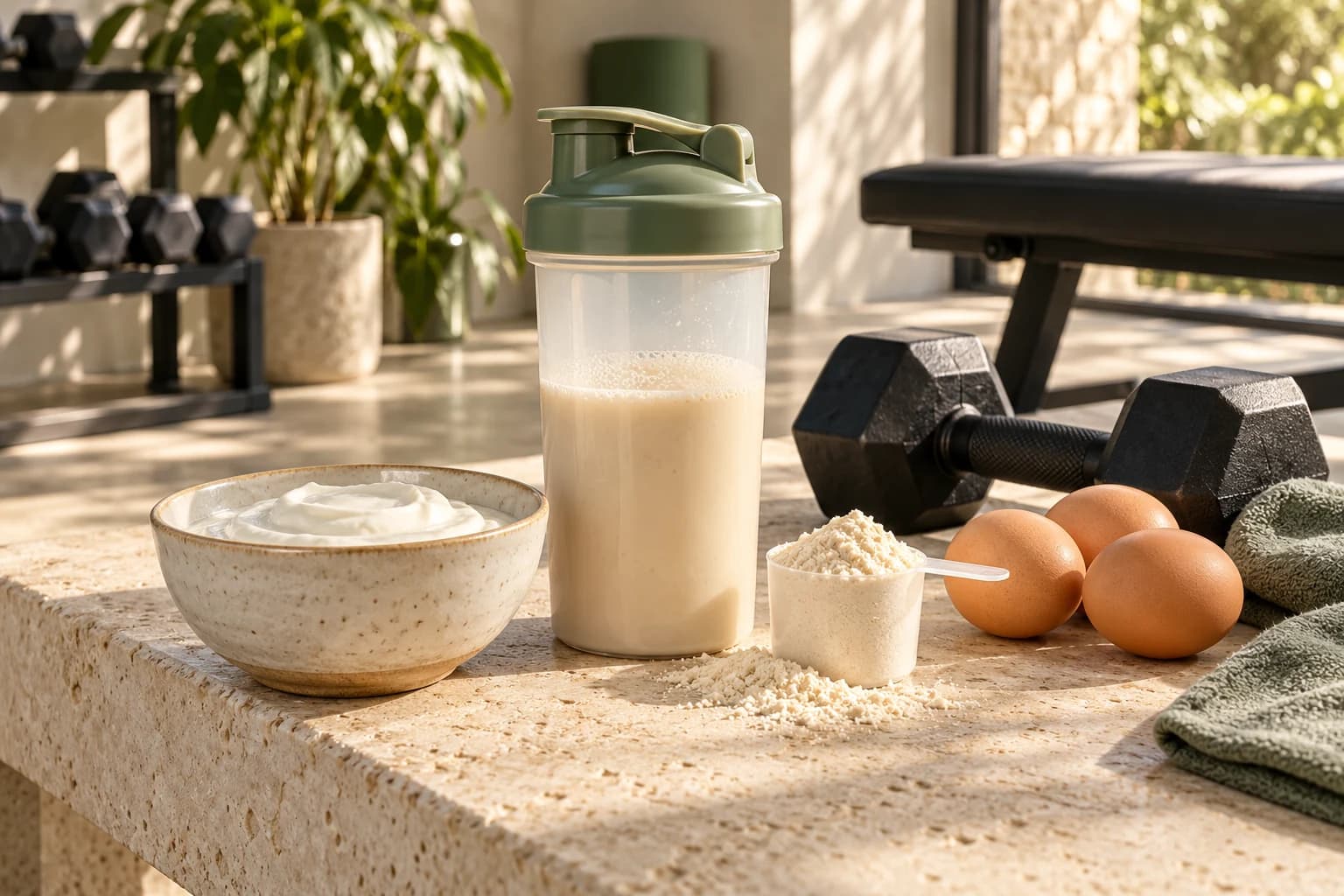
A supplement is one part of a training question
A shaker bottle is easy to buy. Deciding whether it adds anything useful to your routine is a different task. The relevant question is not simply whether protein matters, but whether additional protein improves outcomes beyond the training and food intake already in place. New research revisits that distinction. It offers evidence about average strength gains without making a supplement necessary for every person who lifts weights. Start by separating the workout, your overall diet and the convenience of a powdered product.
What the new review found
Zhang and colleagues’ October 13 Frontiers in Nutrition review pooled 23 randomized trials involving 611 healthy young adults. Compared with resistance training alone, training plus protein supplementation produced average additional gains of 2.63 kg in bench press strength (95% confidence interval 0.77–4.49) and 7.40 kg in squat strength (2.15–12.66). These are pooled between-group differences, not a prediction of what you will lift. The trials varied substantially, mostly involved men, and often did not establish habitual baseline protein intake adequately. That limits a simple answer about who benefits most.
Timing findings are less decisive than a headline
The review explored supplement timing, including intake around training and before sleep. Some subgroup findings favored particular patterns, but timing’s meta-regression result did not meet the conventional statistical-significance threshold. High heterogeneity also remained. This does not establish an urgent post-workout deadline or a universally superior schedule. Avoid turning a subgroup observation into a rule for every meal. The review’s main measured outcomes were bench press and squat strength; they should not be relabeled as equivalent changes in muscle mass.
Food and powder are different ways to organize intake
Protein powder is a convenient source of dietary protein. This comparison does not prove it is superior to an otherwise adequate food-based diet. A supplement can change total intake, timing or convenience; those are distinct explanations for why it might help in a particular routine. An earlier Morton and colleagues review, published online in 2017 and in a 2018 journal issue, also examined supplementation during resistance training. Its analysis found no further fat-free-mass gains above approximately 1.6 g/kg/day of total protein. That research estimate is not an individualized target or a universal ceiling for every clinical situation.
Look at the starting diet before adding more
A hypothetical reader who often misses meals and someone who already follows a well-planned diet are not starting with the same question. Before assuming a scoop solves a problem, describe what you actually eat and which constraint you want to address. Is the issue convenience, an unrecorded portion or uncertainty about your daily pattern? A food log can help organize that conversation, but it is not a direct measurement of absorption or nutritional adequacy. An incomplete record should prompt a question rather than an automatic supplement recommendation.
Keep strength progress tied to the training record
A higher lift can reflect several parts of training, including familiarity with the movement and the program being followed. If you want to review progress, compare sessions with enough detail to understand what changed: exercise, load, repetitions and relevant conditions. Adding a supplement and changing a training plan at the same time makes personal cause-and-effect conclusions difficult. This is a recordkeeping principle, not a way to reproduce a controlled trial at home. A useful history can show a pattern without proving which single change produced it.
There is no dose this article can prescribe for everyone
Protein requirements depend on the individual and the situation. The review does not justify a high-dose supplement recommendation for every reader or extend its results automatically to children, older adults or people with medical conditions. If you have kidney disease or another condition requiring managed protein intake, seek individualized clinical or dietetic advice. The practical goal is an appropriate overall diet alongside suitable training. A supplement’s serving label and an app’s target should not be mistaken for a personal medical prescription.
Where Connefi fits
Connefi supports food portions, macronutrient records and supplement routines alongside workout logs and exercise history. That can help you review the diet and training you recorded together. Nutrition estimates still need checking, and a log does not independently verify intake, absorption or muscle-protein synthesis. PERI can use selected relevant request context to explore supported adjustments for your review. The Nutrition, Training and Methods pages describe those tools and limits. Their purpose is to make the routine easier to organize, not to guarantee a supplement response.
Use the evidence to ask a narrower question
The review supports an average additional strength benefit from supplementation during resistance training in its studied population. It leaves substantial uncertainty about an individual’s response and the best timing. Rather than asking whether protein powder is good in the abstract, ask what it would add to your existing food and training routine. Convenience can be useful; necessity needs a stronger argument. The most informative starting point is the routine you can describe, not the product you feel expected to buy.
Research & sources
Research provides context; it does not validate Connefi’s exact scores or establish individual outcomes.